
Citizenship Inc.: Part 2
In February 2023, the alleged empire that “Inspector Sua” had built around himself appeared to be collapsing. A Thai Lieutenant Police Colonel whose real name was Wasawat Mukurasakul, Inspector Sua stood accused by a Thai politician of owning Thailand’s largest online gambling website with 10 billion baht in circulation. (Online gambling is illegal in Thailand).
The police force quickly suspended Wasawat (citing “absenteeism”) and raided 63 locations associated with his umbrella company, Pentor Group. Over the next few months, 57 people were arrested over four police operations, while authorities seized assets worth more than seven billion baht, including 15 luxury cars and digital currencies, associated with the network.
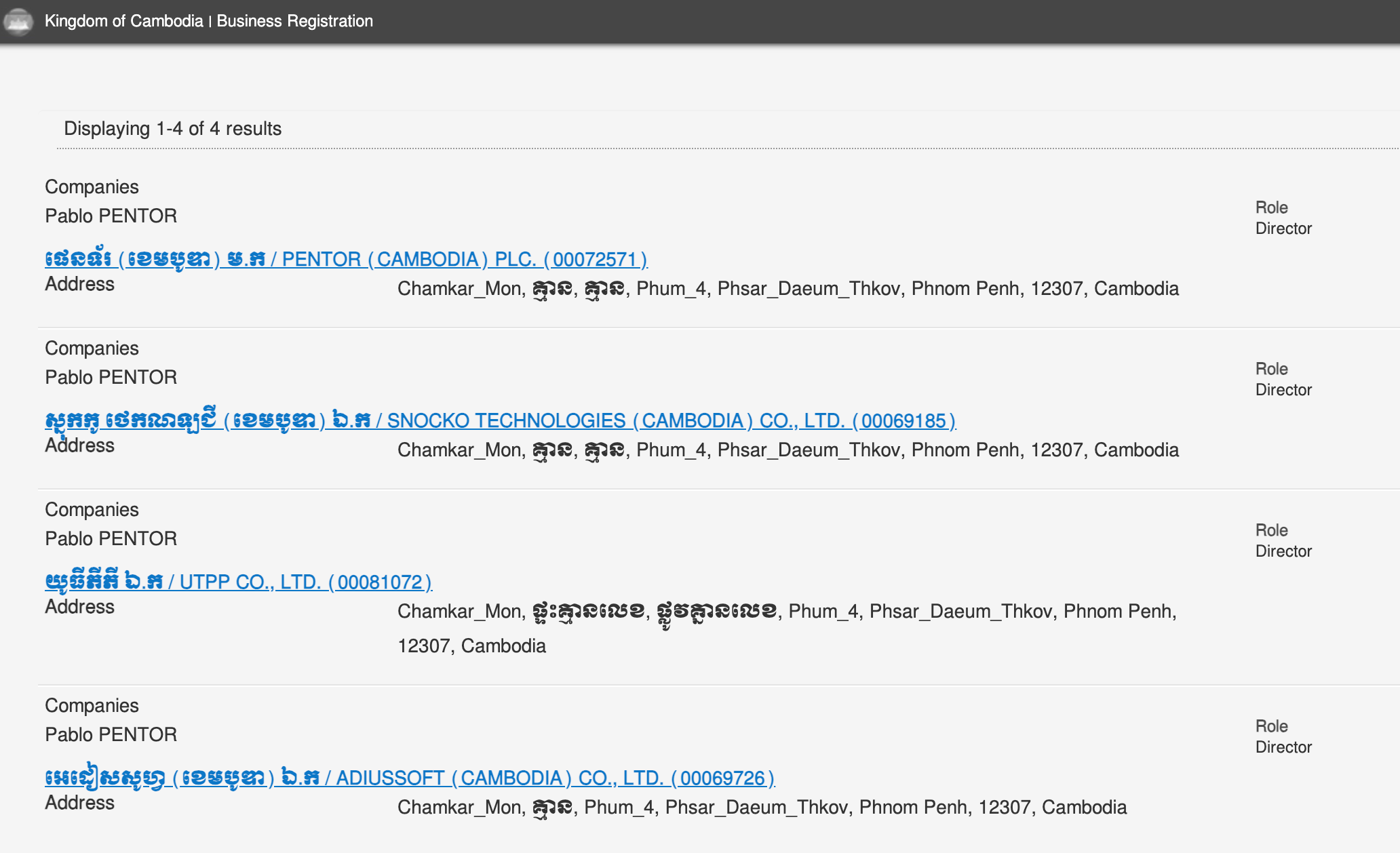
But where was the Inspector? Thai media remained mum on the matter, aside from a comment from the police chief that “19 people who were implicated were believed to have fled overseas” and a Bangkok Post mention that Wasawat was “in hiding abroad”. The Citizenship Inc. database shows that about three months after the accusations, in June 2023, Wasawat and one of his associates both received citizenship in Cambodia, reinventing themselves as Pablo Pentor and Erwin Richford. (Yes, Wasawat named himself after his own company).
Wasawat was not new to doing business in Cambodia: Casino records show he had a Pailin-based casino license as of 2022, though Ministry of Commerce records show no previous companies under his Thai name.
By August 2023, the new business Snocko Technologies — a “computer programming company” — was registered in Cambodia, under none other than Pablo Pentor and Erwin Richford. About six weeks had passed since they were naturalized.
Since then, the duo have registered three more companies, including Pentor (Cambodia) Plc, which describes itself as a “leading international digital financial services provider.” The companies have active Facebook and Telegram channels listing open positions, including game developer, game server developer, branch manager, accountant, and more.
In 2024, Pentor/Wasawat posted photos of the Pailin casino site to Google Maps under his real name, listing himself as CEO:

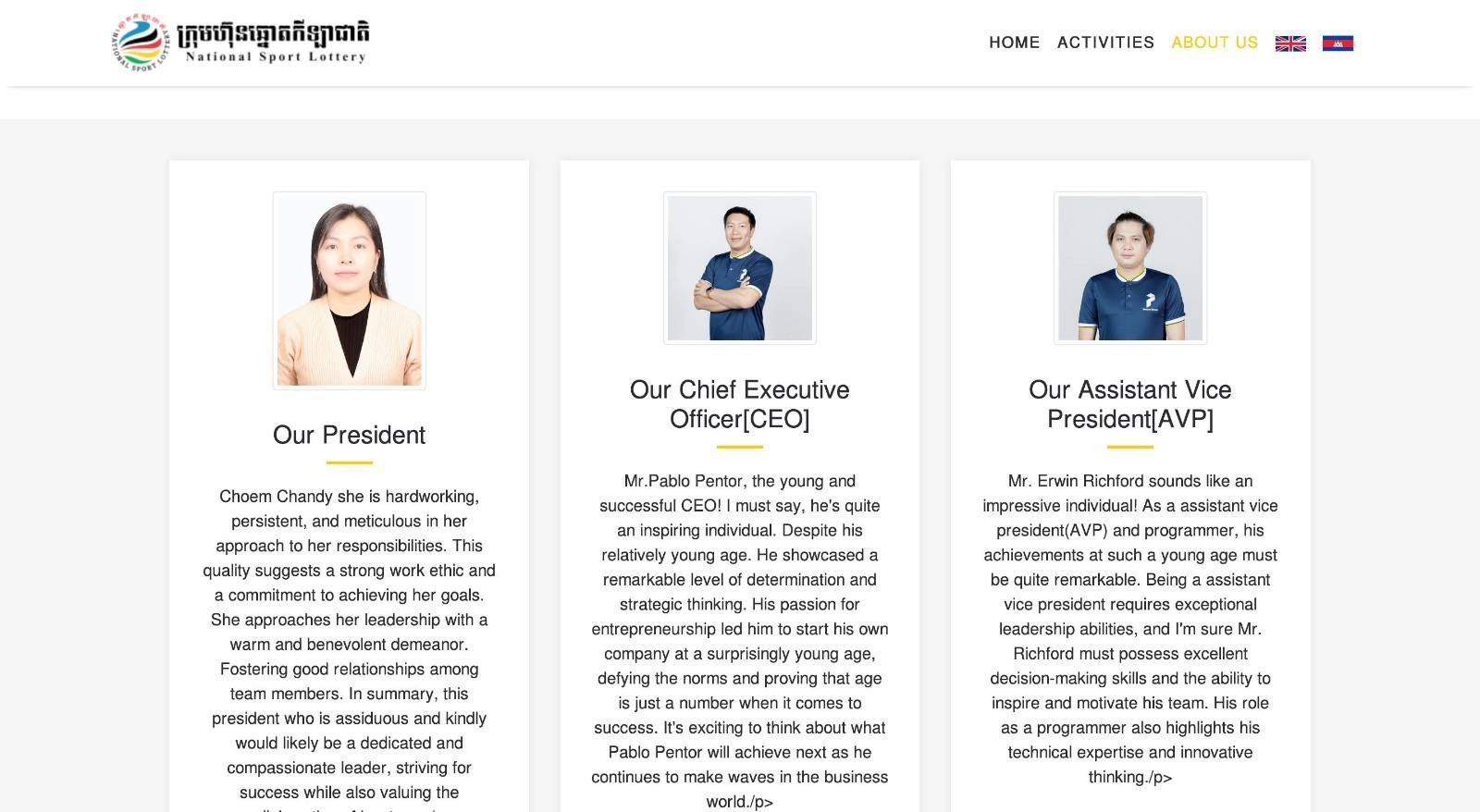
Aside from the name change, Pentor is living an entirely public life in Cambodia. Here’s a photo of him and Richford advertising another business, the National Sport Lottery, which offers a variety of lottery products and claims that “being the biggest lottery seller company in the country must be quite an achievement.” Indeed!
Wasawat/Pentor is a lesser-known example of someone accused or convicted of a crime in another country who has used Cambodian citizenship to create a new identity and rebuild one’s life and businesses.
We draw out his story because 1) it’s the kind of tidbit we enjoy covering in Kouprey and 2) it shows how basic OSINT research, including through this database, can start to build a portrait of activities going on in plain sight — especially in a region with very little free press and high tolerance for criminal behavior.
We’ll dig into this a bit more at the end of the post. But next up:
‘Cambodian’ Shot Dead in Sihanoukville
Around 10pm one evening last week, Lin Ping-wen, an alleged fugitive member of a Taiwanese money laundering network, was walking his dog in Sihanoukville when he was ambushed by three or four gunmen. They reportedly shot him at least 29 times, and he died at a hospital from his wounds.
Although some believed the 56-year-old had fled to Los Angeles, Taiwan’s Criminal Investigation Bureau confirmed media reports that he was indeed the same person who was indicted by the New Taipei District Prosecutors’ Office in 2023. Lin’s indictment was related to the “88 Lounge” money laundering case, in which prime suspect Kuo Che-min and his associates allegedly laundered NT$21.7 billion ($676 million) while running a gambling operation out of a notorious Taipei club by the same name. Taiwanese media describe Lin as the head of the operation’s third-party payment provider.
After his indictment, however, Lin was a no-show at court, prompting prosecutors to seize his NT$3 million bail (US $93,000) in late 2024 and place him on a wanted list. Nonetheless, he was apparently posting actively on Facebook, claiming he fled the country due to “personal reasons” and saying that “I will decide when I return.”
So how did Lin end up in Sihanoukville? You can probably guess: In 2019, he received Cambodian citizenship and chose to keep his name. He did not appear to register any businesses in the country, but he and Kuo — who also got citizenship in 2021 — were pictured at events with Cambodian Prime Minister Hun Manet’s cousin, Hun To. (Credit to CyberScamMonitor for digging up those photos). Readers may remember that Hun To was a director at the US-sanctioned Huione Group, which the US Treasury says “laundered proceeds of virtual currency scams and heists on behalf of malicious cyber actors” for years.
In contrast to Inspector Sua’s easily-traced trail of activities, Lin left less of a mark in Cambodian public records. And yet he, too, appeared to make use of his second citizenship when the authorities came knocking. His case opens up more food for thought: What were the original circumstances of him getting citizenship? What were his relationships, if any, with Cambodian government elites? What business activities may he have been involved with upon relocating to Sihanoukville? And who killed him?
We don’t know — and that’s part of why this system is important to examine. As much as someone like Wasawat/Pentor has left a trail of reinventions, Lin flew under the radar until his killing. But they both seemed to use Cambodia’s immigration system to avoid scrutiny from their home governments.
Here are other stories of note:
The son of Bai Suocheng of the infamous Bai clan, Bay Yin Chin (also spelled Bai Yingcang) was accused of establishing multiple scam compounds in Myanmar’s autonomous Kokang region and smuggling 11 metric tons of methamphetamine. His clan led a smorgasbord of criminal activities including telecom fraud, casinos, homicide, kidnapping, extortion, and forced prostitution, according to Chinese authorities. (Remember Operation 1027?) He received Cambodian citizenship in 2023; was extradited to China in 2024 from Myanmar, and executed for his crimes in February.
In the Philippines’ Sun Valley Clark Hub Corporation in Pampanga, a suspected POGO (Philippine Offshore Gaming Operator)-turned-scam-operation, workers were “treated like slaves,” local journalists reported. The alleged boss was now-fugitive Huang Zhiyang, a Fujian-born, St. Kitts and Nevis national who was naturalized in Cambodia in 2021. Philippine officials went on to charge him with human trafficking and sue him for alleged money laundering.
In 2010, Indonesian national Jerry Hermawan Lo was sentenced to five years in jail in Indonesia for his role in facilitating the murder of another business executive in a plot that also involved the country’s former anti-corruption czar. A decade later in 2020, Jerry got Cambodian citizenship under the name Lo Pichvatanak. Until 2025, he and his son — Tommy Hermawan Lo, another naturalized Cambodian citizen — were directors at Sihanoukville hotel Kampong Dewa and Lionhart Group, which had a casino license registered at Kampong Dewa. Indonesian outlet Tempo has covered the family’s alleged links to online gambling in stories including this one (and Jerry’s denials of being involved in the casino here).
Former Thai deputy interior minister Vatana Asavahame also went into the Cambodian casino business — after a 2010 conviction in Thailand for his role in “one of the largest and longest-running corruption cases in the country’s history.” He got citizenship the same year and has been linked to Grand Diamond Casino, where workers did “online” work (the general Cambodian term for online fraud activities). The casino burned down in a 2022 fire that killed at least 28 people.
As we mentioned in Part 1, nine out of 10 Chinese nationals linked to a billion-dollar money laundering bust in Singapore were naturalized Cambodian citizens. Among them was Chinese national Lin Baoying — the sole woman to be charged — who was sentenced to 15 months jail in 2024. She listed China as her nationality in her 2021 citizenship docs, but she also held Turkish and Dominican passports.
The duo behind the UK-sanctioned Sihanoukville cyberscamming site Kaibo, or KB Hotel, are Chen Allen/Al Len (citizenship 2018) and Xu Aimin (2005). In 2013, Xu was sentenced to 10 years in a Chinese prison for “masterminding an illicit international gambling ring with an estimated turnover of $1.75 billion,” but has remained in Cambodia with active arrest warrants in China and Hong Kong, per RFA. Chen is a prolific donor to the Cambodian Red Cross, but more importantly, both men now carry the distinguished rank of having been sanctioned by the US Treasury.
For anyone who’s made it this far — remember Huione, which we mentioned earlier? Li Xiong, who got naturalized in 2018, served as a director for four Huione businesses, including Huione Pay alongside the prime minister’s cousin Hun To. He was also on the board of Panda Bank before resigning, Camboja reports.
And of course, we’d be remiss if we didn’t finish it off with the Prince Group: Wei Qianjiang (2019), Lei Bo (2018), Zhu Jack (2017), big boss Chen Zhi (2014). And those are just the ones who are sanctioned!
The Herd would also like to note that these examples here are just that — examples. Altogether, some of the figures highlighted here demonstrate how a system intended for legitimate immigration and/or investment is being abused by alleged fugitives and criminals to whitewash their images, continue to find lucrative business streams and abscond accountability at home.
Cambodia stopped releasing this data in 2024. As Jason Tower, a scam expert with the Global Initiative Against Transnational Organized Crime, told OCCRP at the time, Cambodia’s Build-A-Man approach to citizenship means that “criminals can cross borders freely, set up companies and move assets.”
“Now that this data is secret, it is much easier for criminals to use these passports to evade arrest,” he added.
The Herd concurs.
See you next week!
Regarding the “system intended for legitimate immigration and/or investment being abused by alleged fugitives and criminals”.
It is the whole of Cambodia public service that has been corrupted, origins back in the 1990s (See Understanding Pro-Poor Change: 2003 A Case Study of Cambodia. Caroline Hawkins and Tim Conway).
Basically officials everywhere make money to supplement salaries and to share with bosses. Mere nepotism has transformed in to family fiefdoms since Hun Sen in order to hand over the Prime Ministership to his son Hun Manet allowed the same practices in other ministries and institutions. It is ironic that even the Anti-Corruption Unit is now led by father and sons.
Therefore even if change is now intended to be real, lauded and supported in this one area, it will not last, as the entire system is corrupted, all ministries and institutions including those intended to separate powers and to act as checks and balances.
That is why no sensible person should invest private money or that of their taxpayers in Cambodia.