
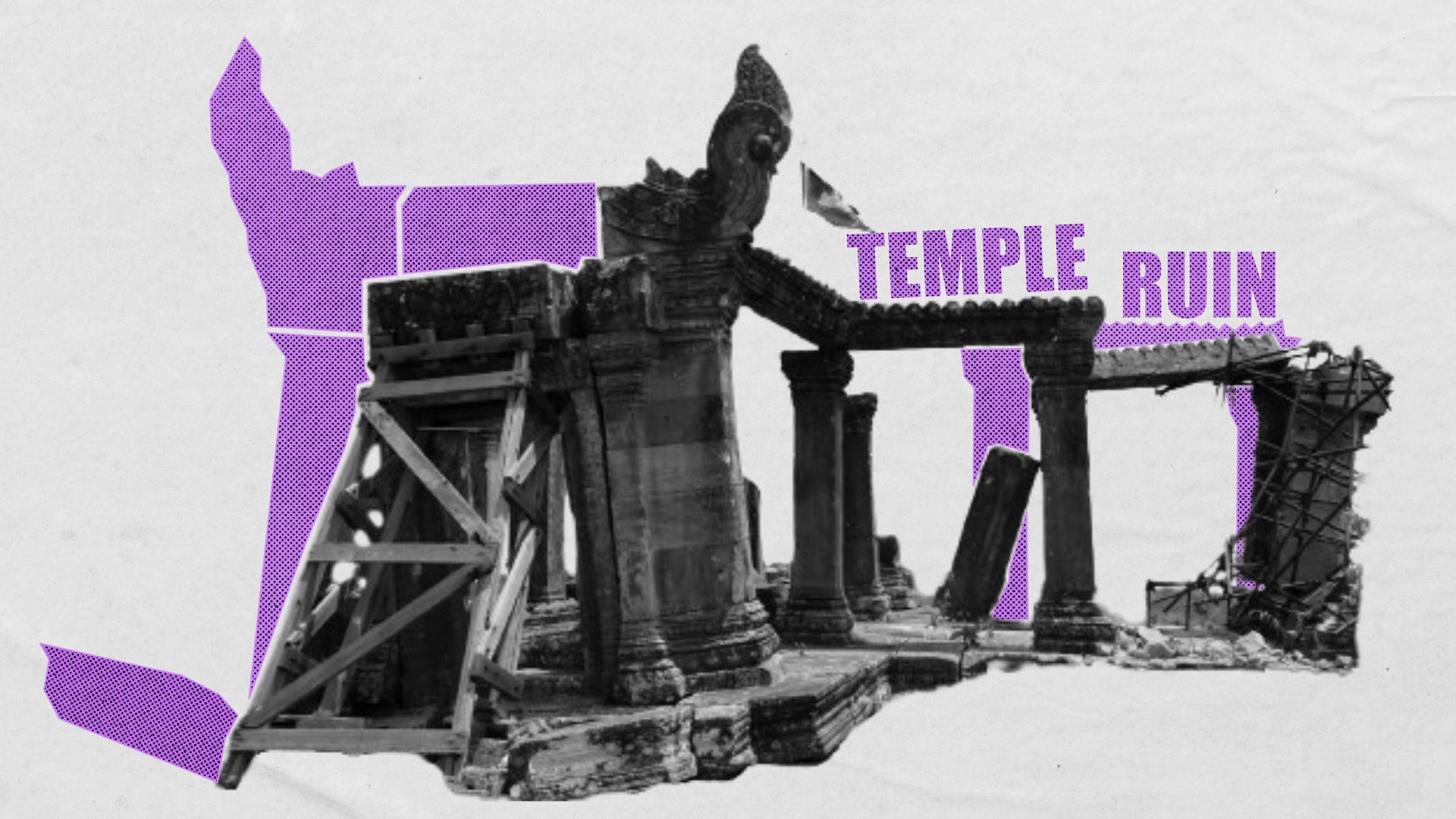
It’s not looking good for Preah Vihear, folks. UNESCO and the International Council on Monuments and Sites released a report this week assessing the damage at the Preah Vihear temple, the heritage site that was caught in the middle of skirmishes between Cambodia and Thailand last July and December.
We’ll get into the bigger picture below, but first here’s a quick rundown:
— As fighting was underway, the temple was hit 142 times in July and 420 times in December. This includes strikes to the temple structure, the surrounding areas and tourism structures within the temple park — not just “military installations”. The report does not clarify what it is talking about when it makes this passing reference to “military installations” — were they there before the conflict or built during the conflict.
— The report finds that many temple walls were scarred by shelling, with ornate decorations completely destroyed and several structures collapsed entirely.
— Most concerningly, the damage to the temple has hurt its integrity and “outstanding universal value.”
Basically, the authors are saying that necessary repairs to the temple will be so extensive in parts that it will impact its authenticity. (Imagine going to Preah Vihear and seeing significant chunks of it newly built as opposed to being restored).
The report, which is peppered with dozens of photos from the temple site, raises concerns over potential restoration of the temple and the need for immediate UXO clearance to aid in these efforts. As a whole, Cambodian Mine Action Centre (CMAC) chief Heng Ratana estimates the cleanup of UXO linked to last year’s fighting could take around a decade and cost a whopping $1 billion.
Preah Vihear is, to say the least, a hot-button issue. Claims to the Angkorian temple have triggered conservative and nationalist sentiment on either side of the border, so it was not surprising the temple damage report supercharged Cambodia’s anti-Thailand rhetoric.
Cambodia this week said the report demonstrates how Thailand intentionally bombed the ancient temple structure and caused extensive damage to it intentionally. The Ministry of Culture accused Thailand of “indiscriminate shelling” at the temple site that had nullified all restoration efforts undertaken in the last decade. The statement was accompanied by two videos: One showing a shell fired at Ta Krabey temple, and the other a collapsing construction crane at Preah Vihear temple.
Additionally, Cambodia released more information to accuse Thailand of using cluster bombs and chemical weapons. Information Minister Neth Pheaktra posted on Facebook that Thailand allegedly deployed around 130,000 rounds of munitions (6-7 million submunitions) across 335 villages and 60 communes during the conflict.
CMAC also said it submitted evidence to the Organisation for the Prohibition of Chemical Weapons that Thailand had used chemical “weapons” and “substances”, impacting around 400 people. CMAC chief Ratana claimed the breast milk from 58 Cambodian mothers was found to have two to three times higher “toxicity levels” than average samples. Ratana, of course, did not provide the actual results or methodology used to reach all these conclusions.
All of this obviously elicited a response from the Thais, who reiterated that Cambodia was using the Preah Vihear Temple complex for military purposes. For those following the December round of fighting, Thailand early on alleged that Cambodia was using the temple site to launch attacks. The Thais also released drone photos last December to show numerous structures around the Preah Vihear temple, which it claimed were military installations. It is difficult to ascertain which structures in the photos were being used for military counterattacks, though some of the marked sites look like camouflaged bunkers. This week, the Thai Army also released drone footage it says shows military bunkers around the temple site, with some shots showing weaponry in the bunkers.


And finally, Cambodia’s propagandist-in-chief Neth Pheaktra posted a video on Facebook allegedly showing Thai soldiers firing from within the Ta Moan Thom temple — which is now in Thailand’s control. The minister alleged that “evidentiary standards cannot be one thing for Cambodia and another for Thailand.” We think this is a silly defense strategy; the minister’s attempt to blame Thailand for using temples for military actions does not absolve Cambodia for supposedly doing the same at Preah Vihear.
Taking all of this together, the Herd is sick of this tiresome back-and-forth. In the absence of independent third-party investigations into the claims — which seem unlikely to come to fruition anytime soon — we will never get to the bottom of who shot first or who used temples as a shield. But what we do know is that a truly unique Angkorian temple site was damaged to a point where its historical value and authenticity may face irreparable damage. It will be some time before Cambodians and foreign tourists will get the chance to ascend to the temple complex and take in its tiered magnificence.
Sar Sokha “suspends” online gambling
Big scam week! As we head into the widely anticipated anti-scam conference next week, the government has been working overtime with a flurry of announcements, including reiterating the ban on online gambling operations and a PM visit to a shuttered scam site at Dara Sakor. There’s also a new report on “scam state architecture” that includes an interesting discussion of naturalizations — more on this later.
First up: Gambling. In a bizarre statement, Interior Minister Sar Sokha last week announced that Cambodia will suspend all online gambling from next month. He was talking about online casinos that livestream their games and make money, which the government finds difficult to control.
If you are confused because you remember that the government outlawed online gambling in 2019, we too were perplexed by Sokha’s announcement, which made it sound like Sar scion had only just discovered livestreamed online casinos. (What did he think JinBei was doing when he was a board member?) The August 2019 prakas issued by then-Prime Minister Hun Sen directed law enforcement to crackdown on all illegal online gambling operations in the country and for the Ministry of Economy and Finance to not renew any existing licenses to operate online gambling.
The Herd can lay out two potential scenarios here: 1) That there are active online gambling operations in the country, and/or 2) That casinos still have active licenses for online gambling. We know the first scenario to be true, because researchers and journalists have documented the resurgence of online gambling alongside fraud and scam activities, with numerous compounds built to house both kinds of operations.
The second scenario seems less likely, but because casino licenses aren’t regularly made public, we can’t say for sure. At face value, it’s difficult to fathom how a casino would still have an active license for online gambling, given that it’s been six years since the prakas came into effect and casinos are required to renew their license annually. The curious bit is Sokha’s use of the word “suspended”. If the practice is already outlawed, how and why is it being suspended as opposed to being shut down?
An article from Kiripost paraphrases Sokha saying that PM Manet wanted to strengthen regulation of the sector before potentially re-authorizing online gambling operations. This would suggest that there are discussions underway to allow the practice to resume — legally — in the country. In any event, this is all a bit farcical, given that online gambling itself never actually stopped. The bottom line is that the government wants to demonstrate its authority over the sector, even if that means tacitly acknowledging that the initial 2019 ban was ineffective.
Speaking of old problems we’re pretending are new! During our week off, PM Hun Manet toured several scam sites in coastal Koh Kong province, including Dara Sakor, with authorities declaring 24-hour surveillance to prevent the return of scamming. We were also treated to a very-serious-looking photo of Manet and local officials crowding around a document.
Dara Sakor, you say? This is big. Dara Sakor is a 36,000-hectare project that covers about 20 percent of Cambodia’s coastline — a land concession that’s about four times larger than is permissible by law. For years following its conception in 2008, the project was dogged by skepticism from the highest levels of the US government, which suspected it was going to become a Chinese military base.
Turns out the developers had something else in mind. By 2022, a compound inside Dara Sakor called Long Bay was well-known as a human trafficking and scam hub. Notably, it wasn’t just journalists and rights groups documenting abuses; the Philippines and Taiwanese embassies publicly called for interventions at Long Bay to rescue their citizens. The UK went on to sanction Long Bay developer Zheng Heng.
So what of this massive, decades-old development project that Cambodia for years defended in the press? Responding to criticism of Dara Sakor in 2019, government spokesperson Phay Siphan told the New York Times “the white people want to hold Cambodia back by stopping us from developing our economy.” Promotional literature quoted in the same article claimed Dara Sakor would “make miracles possible” by turning rural Cambodia into a global logistics hub. It was, to speak plainly, a developmental fantasy of the highest order — catapulted into reality by Cambodia’s freewheeling environment of transnational investment and land-grabbing.
These kinds of megaprojects are important for the Cambodian government’s image of growth and progress. For decades, the Cambodian public has been embroiled in land conflicts as government-linked tycoons and transnational investors seized land for eco-resorts or smart cities or mining concessions, often with partners from China or elsewhere in Southeast Asia. Of course, many of these projects never come to fruition, and some are downright fraudulent. But it’s the illusion of growth that keeps the CPP’s wheels spinning; the idea of build, baby, build, even when the project itself is completely nonsensical.
There’s two ways of reading this. On the one hand, the admission of scamming at Dara Sakor — and the presence of the PM himself — marks a dramatic tonal shift. The government is genuinely acknowledging one of its most high-profile and embattled projects hosted transnational scammers. On the other hand, it’s easy to see how Dara Sakor could fall into the category of scapegoating or exception-making, which is how the government has largely treated the scam industry so far.
This episode also piques our curiosity as to whether Cambodia will make good on its ability to confiscate properties used for scamming. Given its history, Dara Sakor would be a pretty hilarious place to start.
Onto our final item. Scam expert Jacob Sims released another report this week on “Scam State Architecture.” He looks at the network of political-business relationships holding up Cambodia’s scam industry, with special examinations of our favorite Notorious LYP (we inch ever-closer to considering a copyright on that nickname), Chen Zhi and Hun To, among others. The report also takes seriously the Thai-Cambodia border conflict in disrupting the industry but argues its fundamental architecture remains intact.
Sims also analyzed Cambodian naturalization data against Ministry of Commerce records, showing that 4.5 percent of Cambodia’s corporate registry includes at least one naturalized director. He also notes “at least 2,149 naturalized individuals appeared in corporate board positions, and naturalized directors held board seats at nearly triple the rate observed among native-born directors.” That’s pretty staggering, considering there are only a little over 4,000 naturalizations in the first place.
Sims goes on to argue that naturalization produced “jurisdictional ambiguity”, where scam actors “could be treated as Cambodian citizens when sovereignty was useful, transnational investors when legitimacy was needed, and foreign criminals when enforcement pressure finally arrived.” Neat!
That’s it for this week. Ta!
Preah Vihear highlights just how ridiculous both Cambodia and Thailand have been. Given its location, and irespective of which side technically owns it, it is clear that only by co-operating and sharing access to it, can both sides maximize the temple's potential. Both could also have declared it a no-go site for military operations. I'd also wish to remind again one relevant factor to Cambodia's staunch defence of its territory. Why was there no such defence for the vast areas of land handed over to foreign concessions, some Thai? (All well documented by LICADHO - https://www.licadho-cambodia.org/land_concessions)